This is Corvo.
The smallest island in the Azores. The most isolated inhabited point in the entire Portuguese archipelago.
Uncategorized
How People Live in Corvo | Europe's Smallest, Most Isolated Island | 4K Documentary
There is a place in the middle of the Atlantic Ocean where the horizon holds nothing but water.
No coastline. No neighboring island. No lights in the distance.
Just the sea, stretching in every direction, for as far as a human eye can see.
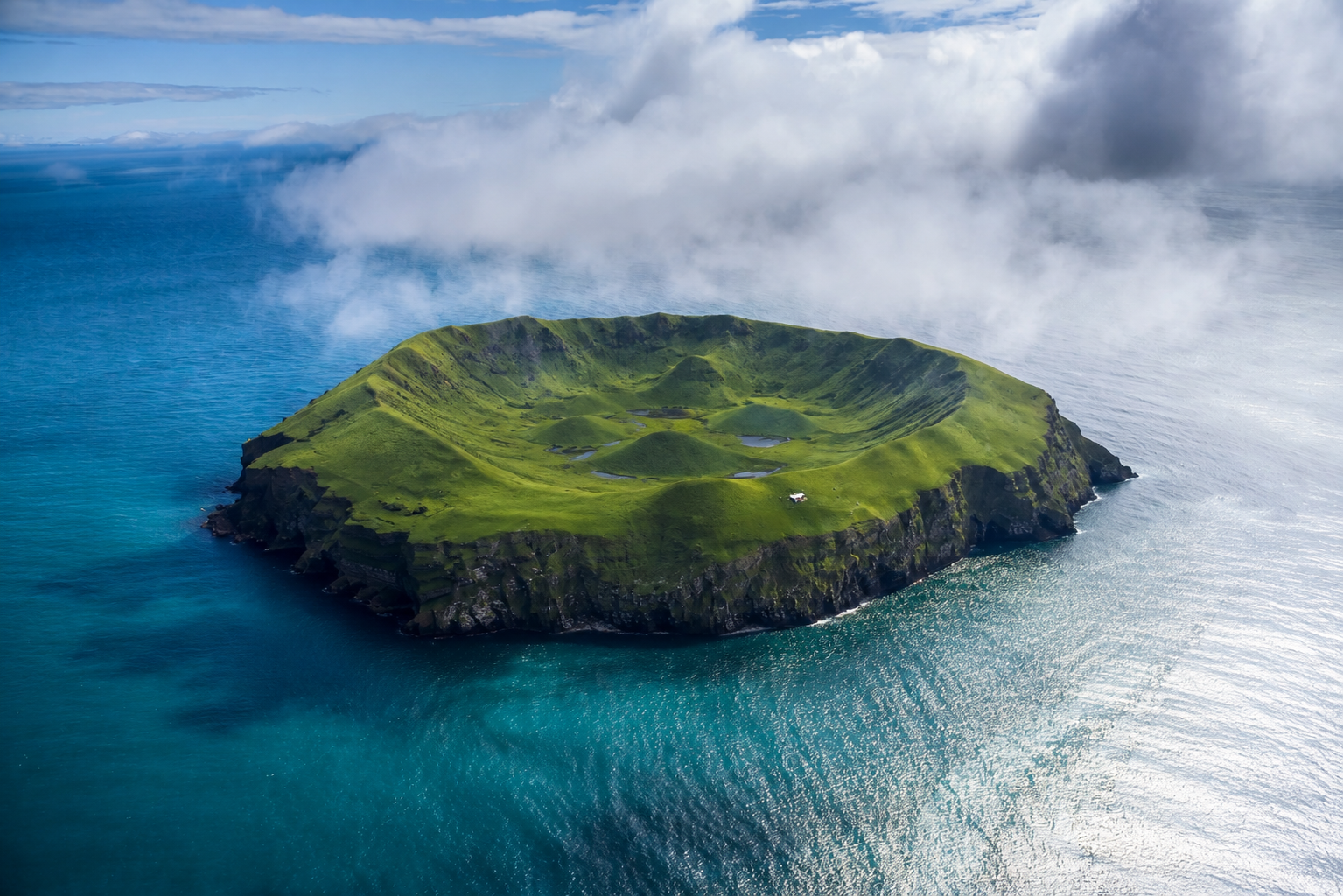
And in the middle of that emptiness, rising out of the waves like a secret the ocean forgot to keep, there is a single volcanic rock.
Seventeen square kilometers.
That's all it is.
You could walk across the entire island in under three hours.
And yet, on this impossibly small piece of land, in the middle of one of the largest oceans on Earth, four hundred and thirty people have built something that most of us would call impossible.
A life.
A real one. With homes, and neighbors, and festivals, and stories passed down through generations who never knew any world but this one.
This is Corvo.
The smallest island in the Azores. The most isolated inhabited point in the entire Portuguese archipelago.
And once you understand what it takes to survive here, you'll never look at "small" the same way again.
Corvo sits at the far northwestern edge of the Azores, paired with its much larger neighbor, Flores, forming the westernmost group of the archipelago. But where Flores has size, Corvo has something else entirely.
Distance.
From here, the nearest mainland — continental Europe — is over a thousand kilometers away. North America is actually closer. Close enough that something extraordinary happens here every autumn, something we'll come back to.
But first, you need to understand what it actually feels like to live on a rock this small, this far from everything.
There is almost no traffic on Corvo. No shopping malls. No skyscrapers. No highways stretching toward some other city.
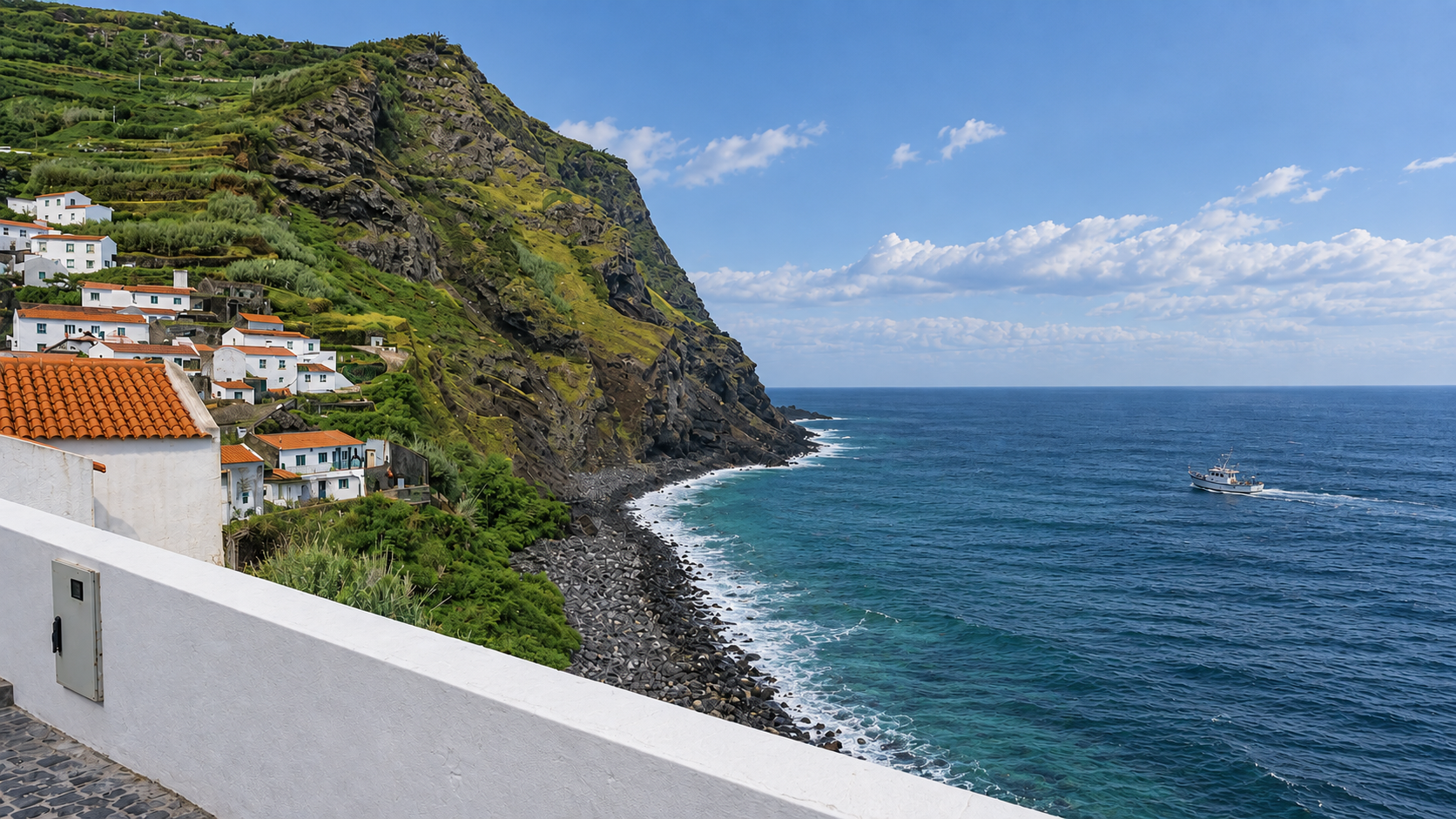
Nearly the entire population lives in a single settlement — Vila do Corvo — a cluster of stone houses and narrow, winding streets that has barely changed its footprint in centuries.
Walk through it, and you feel it immediately: this was never built for convenience. It was built for survival.
The houses sit close together, walls made of volcanic stone, shaped not by architects chasing an aesthetic, but by generations of people trying to stay warm against Atlantic winds that can turn violent with almost no warning.
And that's the first thing you learn about Corvo. Here, nature doesn't sit politely in the background of daily life.
Nature is daily life.
When the wind changes direction, transportation changes with it. When fog rolls in — and it rolls in often — the island disappears even further from the rest of the world. When the Atlantic swells, the sea crossing that connects Corvo to its sister island becomes something you don't attempt.
The people of Corvo learned, over hundreds of years, a lesson that most of the modern world has forgotten:
You don't conquer this ocean.
You live inside its permission.
To understand why, you have to go back — not centuries, but millions of years, to a time before there were any people here at all, before there was an island here at all.
Corvo is the visible remnant of a massive volcanic system, one that began forming somewhere between one and one and a half million years ago, rising slowly from the ocean floor through repeated eruptions and lava flows, until it broke the surface and became land.
And at the heart of that land sits the feature that defines everything about this place.
The Caldeirão.
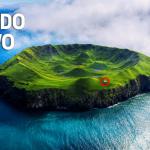
A volcanic caldera roughly two point three kilometers wide, plunging more than three hundred meters deep — the collapsed summit of the very volcano that built this island in the first place.
Stand at its rim today, and you're not looking at an active volcano. You're looking at the silence that comes after.
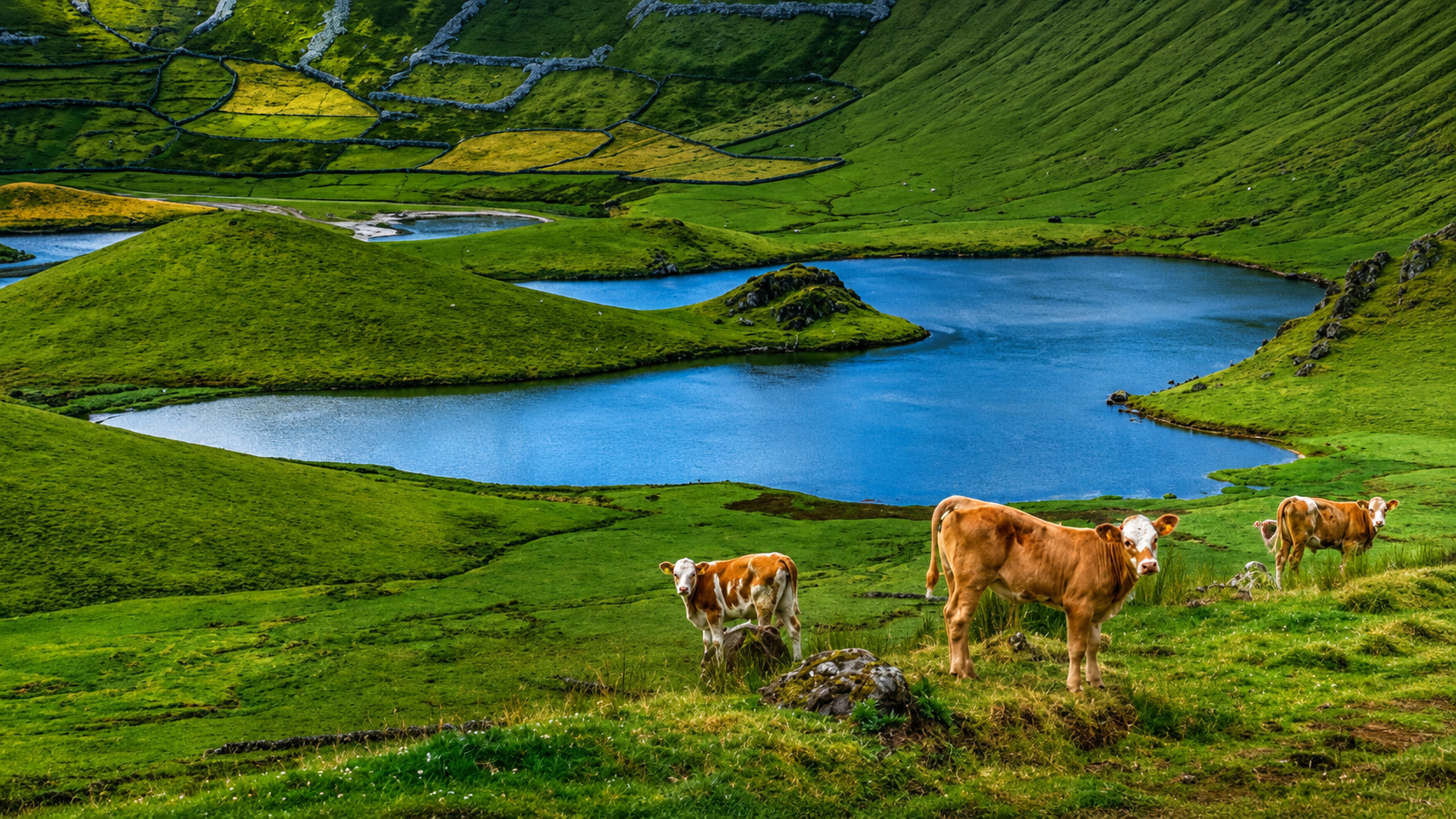
Green slopes fall away beneath you. Small lakes rest at the bottom, mirroring the sky. Tiny volcanic cones rise from the crater floor like miniature islands inside the island itself — as if someone had built an entire second world down there, hidden from the ocean above.
It is, without exaggeration, one of the most striking landscapes anywhere in the Azores. And it explains something essential about Corvo:
This is not just a small island.
This is a small island sitting directly on top of an enormous geological story.
And the people who eventually settled here didn't just admire that story. They built their lives around it.
Down inside the Caldeirão, between two of its lakes, sit the ruins of an old water mill — dated by local records to the late nineteenth or early twentieth century, designed to use the difference in water level between the two lakes to do its work.
Today it's little more than stone and memory. But it tells you something important.
Corvo was never simply wild. It was never simply left alone.
For as long as people have lived here, there has been a relationship — a negotiation, really — between the volcano, the ocean, and the humans caught between them.
Farming. Livestock. Fishing.
A way of life built specifically for the limits of this place, and nowhere else.
Because on an island this isolated, everything you need either comes from the sea, or it comes from the land you're standing on. There is no third option.
The ocean, meanwhile, plays a strange double role in the story of Corvo. It is the wall that separates this island from the rest of humanity — and, at the very same time, it is the road that connects it.
The sea kept Corvo distant.
But the sea is also what fed its people, carried its boats, and — eventually — carried word of this place to a wider world.
Beyond the water, there was Flores. Beyond Flores, mainland Portugal. And somewhere across the endless blue in the other direction, a new continent where waves of Azorean families would eventually search for a different kind of life.
Walk the streets of Vila do Corvo today, and that layered history is still visible in the stone.
Old walls. Traditional houses. Narrow paths that were never meant to fit a car, because for most of this island's history, there were no cars to fit.
This place wasn't designed.
It grew — the way a life grows, out of necessity, one generation at a time.
And being small never meant being easy.
If anything, it meant the opposite. Surviving as a tiny community in the middle of an ocean requires something modern life rarely demands of us anymore: total interdependence.
Here, what happens to one family can ripple through the entire island.
There is nowhere to disappear to. No anonymity. No stranger down the street.
Which might be exactly what makes Corvo feel so different from almost anywhere else you've ever been.
People here still know each other. Truly know each other. The streets still belong to a community, not just to traffic. And the island has, against every modern pressure, managed to stay remarkably close to a human scale.
That isolation shapes even the smallest details of daily life here.
Supplies don't simply arrive on Corvo the way they arrive almost everywhere else in Europe. They depend on weather, on sea conditions, on whether a boat can safely cross the channel from Flores, or whether a small plane can land on a runway exposed to Atlantic winds.
A delay that would be a minor inconvenience anywhere else can mean, on Corvo, going without something for days.
And so life here moves according to a different clock. Not the clock on a wall, but the clock written into the sky and the sea.
People check the wind the way city dwellers check their phones.
They read the clouds the way others read a schedule.
For a visitor, this rhythm can feel almost meditative — a rare, genuine escape from the noise of modern life. For the people who actually live here, it is simply how things have always worked. Isolation isn't an experience they chose for a weekend. It's the water they've swum in their entire lives.
And maybe that's exactly why community means something different here than it does almost anywhere else.
In a place this small, a single family's hardship rarely stays private for long. Word travels fast through streets where everyone already knows your name, your parents' names, and the house you grew up in.
That closeness built something durable over the centuries — a culture where neighbors are not simply people who happen to live nearby, but people you can actually depend on when the ocean makes everything else uncertain.
It shows up in the island's traditions, too. Each August, the streets of Vila do Corvo fill for the feast of Nossa Senhora dos Milagres — a religious celebration rooted in a local story of survival passed down through generations, of a community that endured when it seemed like it might not.
Whether every detail of that old story can be proven today matters less than what it represents.
Because in a place this small, history doesn't just live in books.
It lives in a festival. In a stone wall. In a story told by someone's grandmother.
And it's precisely because Corvo has stayed so small, so resistant to change, that so much of that memory has survived intact.
But Corvo's isolation isn't only about the people who call it home.
Because above this tiny volcanic rock, the sky itself never quite stops moving.
And that's where Corvo's other secret begins.
Its birds.
Every autumn, something happens on Corvo that has nothing to do with the four hundred and thirty people who live here.
Something arrives from thousands of kilometers away, completely by accident.
Birds.
Not the birds you'd expect to find on a European island. Birds that, by every normal rule of geography, shouldn't be here at all.
Species native to North America. Species that belong on the other side of the Atlantic, following migration routes that were never supposed to bring them anywhere near this tiny volcanic rock.
And yet, almost every year, some of them end up here anyway.
Here's why. Corvo sits almost exactly between two continents — Europe and North America — in the middle of an ocean so vast that a single mistake in a bird's internal compass can carry it hundreds of kilometers off course. A sudden storm. A shift in the wind. A moment of disorientation somewhere over open water.
And when that happens, a bird that started its journey over Canada or the northeastern United States can find itself, days later, completely lost above the endless Atlantic — with nothing below it but water in every direction.
Until, by pure chance, it spots something impossible.
Land.
Seventeen square kilometers of it, rising out of nowhere.
For an exhausted bird thousands of kilometers off course, Corvo isn't just an island. It's the only option left.
This is not a small curiosity. It has turned Corvo into one of the most extraordinary destinations on Earth for birdwatchers — a place where, in a single autumn morning, someone might spot a species that hasn't been recorded anywhere else in Europe that entire year.
People fly here specifically for this. Not to see Corvo's villages, or its crater, or its stone walls — although they usually leave loving all three — but to stand quietly with binoculars, waiting for the ocean to deliver something it was never supposed to.
And every single sighting matters far beyond the moment itself. Each lost bird that turns up on Corvo gives scientists a small piece of a much larger puzzle: how migration actually works across an ocean this size, how storms reshape ancient flight paths, how nature improvises when its own maps fail.
In other words, Corvo isn't just a place birds accidentally end up.
It's a place where science quietly happens, made possible only because this island exists exactly where it does — impossibly isolated, impossibly small, and impossibly perfectly placed.
But the birds are only part of what makes Corvo's natural world so remarkable.
Because underneath their flight paths sits a landscape unlike almost anywhere else in the Azores.
Remember the Caldeirão — the massive volcanic caldera at the island's center, over two kilometers wide and more than three hundred meters deep. Look closer, and you start to understand it's not just a dramatic view.
It's a self-contained ecosystem.
Small lakes rest at the bottom, reflecting a sky that changes by the hour. Miniature volcanic cones rise up from the crater floor, some of them tied in local tradition to the nine islands of the Azores themselves — nature accidentally creating a symbol.
And scattered across those slopes, hidden in that damp, isolated microclimate, live species found almost nowhere else on the planet.
According to regional nature park records, roughly forty-eight plant species here are endemic to the Azores alone. UNESCO's own documentation goes further, recording ninety-three endemic species on Corvo in total — an extraordinary density of rare and threatened life for an island this size.
Think about what that actually means.
A piece of land you could walk across in an afternoon holds one of the highest concentrations of unique, irreplaceable species anywhere in the entire archipelago.
That's not an accident of nature. It's a direct result of isolation itself.
When a species is cut off long enough — sealed away on a small island, surrounded by open ocean, with almost no outside contact — it doesn't just survive. Over enough time, it evolves into something that exists nowhere else on Earth.
Corvo's extreme remoteness, the very thing that makes daily life here so demanding for its human residents, is the exact same force that made this island a refuge for species found in no other place on the planet.
Isolation nearly broke this island's connection to the rest of humanity.
And isolation is also precisely what saved its wildlife.
That contradiction is central to understanding Corvo — and it's exactly why, in 2007, the entire island was recognized by UNESCO as a Biosphere Reserve under its Man and the Biosphere Programme.
This designation isn't symbolic. It comes with responsibility.
The reserve covers not just the island's land area, but the vast marine territory surrounding it — roughly twenty-five thousand eight hundred and fifty-three hectares in total, the overwhelming majority of it ocean.
Which reveals something most visitors never quite realize.
Corvo isn't really a small island floating in a big ocean.
Corvo is a small piece of land sitting at the center of an enormous marine ecosystem — one that includes underwater caves, coastal cliffs, and countless microhabitats along its southern shoreline, shaped over thousands of years by relentless Atlantic waves.
Some of those cliffs are almost impossibly steep, carved by an ocean that has never once stopped working on this coastline.
And it's still working today.
The volcano built this island. The ocean has spent every day since slowly reshaping it — eroding a little more here, smoothing a little more there, in a process too slow for any single human lifetime to notice, but too relentless to ever truly stop.
Nothing about Corvo's landscape is actually as permanent as it looks.
Which might be the quietest, strangest truth about this place. Standing at the edge of the Caldeirão, everything around you feels ancient, eternal, unmovable.
But you're actually standing inside a live geological process — one chapter in a story that started roughly a million years ago and is still being written, wave by wave, one storm at a time.
Corvo doesn't just sit still and wait to be discovered.
It keeps changing.
And so, in a strange way, does everyone who spends enough time trying to understand it.
Because Corvo carries more than one layer of protection, and each one tells a different part of its story.
Alongside the Biosphere Reserve status, parts of the island fall under the Natura 2000 network, a European framework designed to safeguard habitats and species considered vital to the continent as a whole. Its wetlands hold Ramsar status, recognizing them as internationally significant. And its volcanic landscape is included within the Azores UNESCO Global Geopark, a designation reserved for places where geology itself is considered worth protecting.
Four different frameworks. Four different reasons.
One bird sanctuary. One wetland system. One geological record. One fragile web of endemic life.
And all of it, somehow, packed onto seventeen square kilometers of rock in the middle of an ocean most people will never cross.
It would be easy to assume a place this small couldn't matter much on a planetary scale.
Corvo proves the opposite.
Small islands like this one are often described by scientists as some of the most fragile parts of any larger natural system — precisely because they're small. There's no room for error. No larger landmass to absorb a mistake. A single disruption here can ripple through an entire ecosystem in a way it never could on a continent.
Which is why Corvo's future depends on a genuinely delicate balance.
On one side, there's growing interest from travelers around the world who want to witness this place for themselves — the crater, the birds, the impossible sense of remoteness. On the other side is the uncomfortable truth that the very thing drawing them here is also the thing too much attention could quietly destroy.
If Corvo were ever flooded with visitors the way larger, better-connected destinations are, the qualities that make it extraordinary — its silence, its slow pace, its untouched landscape — could begin to disappear. Not overnight, but gradually, the way most fragile things are lost.
That's why so much of Corvo's future depends not on growing bigger, but on staying exactly what it already is.
A part of the ocean's memory.
A refuge for species with nowhere else to go.
And a community that has spent centuries learning something the rest of the world is only beginning to relearn: that size was never really the point.
Endurance was.
Morning on Corvo doesn't arrive the way it does in a city.
There's no traffic building up outside the window. No rush of people moving toward somewhere else. The wind moves through the streets of Vila do Corvo before anyone else does, and clouds drift toward the island's higher ground, sometimes swallowing the entire landscape in fog within minutes.
Here, weather isn't background noise to daily life. It's woven directly into it.
Because while the physical distance between land and sea on Corvo is short, the distance between this island and the rest of the world remains enormous — and that distance shapes almost everything about how four hundred and thirty people build a life here.
Vila do Corvo is the only settlement on the entire island, which makes it, by population, one of the smallest towns not just in the Azores, but in all of Europe.
But the real story here was never just about a low number on a census.
It's about how a community this small has managed, generation after generation, to build something that actually works.
Walk its old streets and you feel it immediately. Houses stand close together. The streets are narrow, curving in ways that feel more organic than planned. Stone walls and traditional architecture hold the memory of the island's past in every corner.
None of this was designed for appearance.
It was designed for survival — protection from wind, from rain, from the unpredictable temper of an ocean that surrounds this place on every side. And in a small community, building homes close together simply made sense. It kept people connected, in every sense of the word.
That shared way of life shaped Corvo's culture just as much as it shaped its architecture.
For generations, farming, livestock, and fishing formed the backbone of survival here. Even today, with modern transportation and communication technology having changed daily life considerably, that rural character hasn't disappeared. Animals still graze across the island's green hillsides. Much of the land is still shaped by small-scale agriculture and grazing, the same way it has been for centuries.
Which means Corvo was never simply "untouched wilderness."
It's something more layered than that — a cultural landscape, shaped slowly and deliberately by the people who've lived on it, generation after generation.
You can see that layered history clearly in the island's old stone-walled fields, where small enclosed parcels once controlled livestock and organized farming. From a distance, those walls look like a natural part of the scenery.
Get close, though, and you realize what they actually are.
Not just stone.
Decades — sometimes centuries — of labor. A family's history, held together one placed rock at a time. The story of a field. The patience of people who built a life here with almost nothing handed to them.
Time moves differently on Corvo, and it's not always easy to explain why until you've actually experienced it.
Part of that comes from something visitors often find peaceful, but that residents experience very differently: real, practical isolation.
Supply runs, transportation, and the weather itself are constant, unavoidable parts of daily life. Sea crossings can be delayed by rough conditions. Flights can be pushed back. A journey that should take a few hours can, without warning, stretch into an entire extra day, simply because the Atlantic decided it would.
For someone visiting Corvo, that unpredictability can feel almost romantic — a genuine break from a hyper-scheduled modern life.
For the people who actually live here, it's simply how things have always worked. Not an aesthetic. A reality.
And that reality is exactly why community means something different on Corvo than it does almost anywhere else.
In small, tightly-knit places like this, people depend on each other in ways that are easy to forget in larger societies. A single family's hardship rarely stays private for long — word moves quickly through streets where almost everyone already knows your name, and probably your parents' names too.
That sense of shared responsibility isn't just a nice idea here.
It's practically survival infrastructure.
You can see it clearly in Corvo's cultural calendar. Like much of the Azores, religious festivals, music, food, and community gatherings hold real weight in local life. One of the most significant is the feast of Nossa Senhora dos Milagres, celebrated every year on the fifteenth of August — a tradition rooted in a local story of the island surviving an attack long ago, an account preserved and passed down almost entirely through oral memory rather than official record.
Whether every detail of that story holds up to historical scrutiny matters less than what it represents.
Because on an island this small, history was never confined to books.
It lives in festivals. In the front of a church. In stories still being told by someone's grandmother, exactly the way they were told to her.
That's the guiding philosophy behind Corvo's Ecomuseum, an institution built on a simple but powerful idea: instead of locking the island's history inside a single building, spread it across the real places where that history actually happened.
Casa da Vegia. Casa da Memória. Casa do Tempo. And the ruins of an old grain-processing structure known as the Atafona do Lourenço — the last surviving example of its kind on the island.
Casa do Tempo sits inside the old fabric of Vila do Corvo itself, standing as one of the key structures used to tell the island's story. The Atafona do Lourenço, meanwhile, is a quiet reminder that Corvo's economy was never built on livestock alone — grain production mattered here too, once upon a time.
By modern standards, these structures look small. Almost primitive.
But for an island community this isolated, producing your own food wasn't a lifestyle choice. It was survival.
When a storm closed the sea route, supplies simply didn't come. When a ship was delayed, daily life had to adjust around that delay, not the other way around. So the people of Corvo learned, out of pure necessity, to rely on what the island itself could provide.
That instinct — self-reliance, built out of genuine necessity — became part of the island's cultural DNA.
And you can still feel its presence in the character of Corvo today.
None of this means the island exists in a vacuum, though.
Modern transportation, communication technology, and infrastructure have connected Corvo to the wider world in ways earlier generations couldn't have imagined. But weather still governs daily life here more directly than almost anywhere else in Europe. A delayed flight, a canceled ferry — these aren't rare inconveniences on Corvo. They're regular, expected reminders of exactly how far this island really is from everything else.
Which means a trip to Corvo was never really just a trip.
It's a genuine departure from the speed of the modern world — even if only for a few days.
Because here, there's very little to rush toward.
The island seems to quietly teach you how to wait. For clouds to shift. For the sea to calm. For sunlight to finally break through fog. And sometimes, simply, for nothing at all to happen.
That's not an easy lesson for most of us.
Modern life is built on urgency. Notifications. Movement. Cities that never stop expanding, and a constant, low-grade pressure to keep up.
Corvo offers something almost entirely opposite.
A reminder that sometimes, the fullest way to experience being alive is simply to stand still, in one place, and actually notice it.
Stand at the edge of the Caldeirão at the right moment, and you understand that feeling completely.
The crater opens up in front of you, vast and green, its slopes falling away toward small lakes that mirror whatever the sky is doing that day. Tiny volcanic cones rise from the floor below, scattered like something deliberately arranged, even though nature built every piece of it on its own.
Some locals connect those small cones, in the island's oral tradition, to the nine islands of the wider Azores — geology quietly turning into folklore, the way it often does in places old enough to have both.
For someone from Corvo, that view isn't just scenery. It's identity.
For a visitor, it's a glimpse of exactly how powerful nature can be when left mostly alone.
And if you stay quiet long enough at that rim, you start to notice something else. The Caldeirão isn't silent at all.
Wind moves across the grass. Somewhere below, water shifts. And if you're patient — if you're lucky — you might catch sight of a bird that has absolutely no business being there, blown thousands of kilometers off its intended path, resting for a moment on an island that exists, almost impossibly, exactly where it needed to be.
From a distance, the first thing you notice about Corvo is how small it looks.
Spend even a short time actually standing on it, and that impression starts to fall apart.
Because Corvo isn't small. Not really. Its true scale was simply never meant to be measured in square kilometers.
Its real size begins in the ocean surrounding it — in the countless kilometers of open Atlantic that separate this island from everything most of us consider "normal" life. Seventeen square kilometers of volcanic rock, holding a few hundred people, in the middle of one of the largest oceans on the planet.
By almost any modern standard, that shouldn't work.
And yet it has worked, for centuries.
People were born here. They worked this land. They fell in love here, raised children here, built entire lives inside the boundaries of a place you could walk across before lunch. Some eventually left, chasing opportunity somewhere larger. Some came back, unable to stay away for long. And some never left at all, spending an entire lifetime on this single, impossibly small piece of land.
Which means the most remarkable thing about Corvo was never really its isolation.
It's that life kept going anyway, in spite of it.
For most of this island's history, reaching Corvo depended entirely on the mood of the ocean. When the Atlantic stayed calm, the connection to the outside world held. When it didn't, the island quietly closed in on itself again, the way it always had.
That single fact shaped everything about how people here learned to plan a life. Here, making a decision meant factoring in something far bigger than yourself. The sea got a vote. So did the wind. So, sometimes, did the fog.
That dynamic hasn't disappeared today. Modern flights, ferries, and communication technology have connected Corvo to the rest of the world in ways earlier generations couldn't have imagined.
But weather still has the final word here more often than almost anywhere else in Europe.
A delayed flight. A canceled crossing. Small moments that quietly remind everyone — residents and visitors alike — exactly how far away this island really is.
Which is why arriving on Corvo was never simply a matter of travel.
It's a genuine, forced departure from the pace of modern life, even if only for a few days.
Most visitors notice it almost immediately.
There's very little urgency here. The island seems to teach you, almost against your will, how to wait. For clouds to lift. For the sea to settle. For sunlight to finally break through fog that seemed permanent an hour earlier.
For many of us, that's a genuinely difficult skill to relearn.
Modern life runs on urgency — notifications, deadlines, cities that never stop expanding, a quiet, constant pressure to always be moving toward something else.
Corvo offers the opposite of all of it.
And nowhere does that feeling reach its peak quite like the edge of the Caldeirão.
Step up to that rim, and the view opens all at once — a vast green crater falling away beneath you, small lakes catching whatever light the sky happens to offer that day, tiny volcanic cones scattered across the floor below like a second, hidden landscape tucked inside the island itself.
Local tradition ties some of those cones to the nine islands of the wider Azores — geology quietly becoming folklore, the way it so often does in places old enough to hold both.
For someone from Corvo, that view is more than scenery.
It's identity, laid out in stone and grass and water.
For a visitor, it's raw proof of exactly how powerful nature becomes when it's mostly left to itself.
And if you stay quiet at that rim long enough, you'll notice the Caldeirão isn't silent at all. Wind moves steadily across the grass. Somewhere below, water shifts almost imperceptibly. And if you're patient — genuinely patient — you might catch sight of a bird that has no reasonable explanation for being there at all, blown thousands of kilometers off its intended path, resting for a moment on the one small piece of land that happened to be exactly where it needed to be.
That, in many ways, is Corvo's entire story, compressed into a single image.
Something small. Something remote. Something that, against every reasonable expectation, becomes exactly what's needed at exactly the right moment.
The island's beauty was never really about its size.
It's about how much has managed to survive inside such a small space — a rare ecosystem home to dozens of species found nowhere else on the planet, a centuries-old human community that never stopped adapting, and a landscape still actively being written by forces far older and far larger than anyone standing on it today.
Corvo's future depends on protecting exactly that balance.
Interest in this island is growing. More travelers now want to witness the crater, the birds, the almost otherworldly sense of remoteness for themselves. But the very isolation that makes Corvo so extraordinary is also, unavoidably, its most fragile asset.
Too much attention, too quickly, risks eroding the very qualities that make this place worth protecting in the first place — its silence, its unhurried pace, its landscape that has stayed remarkably close to what it always was.
Which is exactly why Corvo's value was never really about growing bigger.
It's about staying exactly what it already is.
A refuge for species with nowhere else on Earth to go.
A living record of a volcano that built an entire island, and an ocean that has spent a million years quietly reshaping it ever since.
And a community that has spent centuries proving something the rest of the world seems to be relearning all over again.
That size was never really the point.
Endurance was.
Because somewhere in the middle of the Atlantic, far from almost everything most of us call ordinary life, there's still a small volcanic island where four hundred and thirty people wake up every morning and simply keep going.
Not because it's easy.
Because, generation after generation, they've made the deliberate choice to keep choosing it.
That's Corvo.
A place small enough to walk across in an afternoon.
And large enough to hold an entire world.
If you ever find yourself standing on Corvo — at the rim of the Caldeirão, in the narrow streets of Vila do Corvo, or simply at the edge of the island watching the Atlantic stretch out toward a horizon with nothing on it — you start to understand something that's genuinely hard to explain until you've felt it yourself.
This isn't a place you visit to escape the world.
It's a place that shows you, quietly and without asking for anything in return, exactly what a small, determined community is capable of when it refuses to disappear.
Because the truth is, most of the planet has forgotten what it looks like to live this close to the edge of things. Close to the ocean. Close to the weather. Close to a volcano that built the very ground beneath your feet, and close enough to your neighbors that survival was never something you had to face alone.
Corvo hasn't forgotten.
If anything, that closeness is exactly what this island has spent centuries protecting.
Every stone wall in its fields. Every narrow street in Vila do Corvo. Every festival held every August, telling the same story a little differently each time. Every bird that lands here by accident and, without knowing it, becomes a tiny piece of a much larger scientific record.
None of it happened because Corvo was easy.
It happened because the people here decided, generation after generation, that this impossibly small piece of land in the middle of an impossibly large ocean was worth staying for.
And maybe that's the real reason this island stays with people long after they leave it.
Not the crater. Not the birds. Not even the silence, as rare and as striking as it is.
It's the reminder that somewhere out there, far from almost everything the modern world considers normal, life still finds a way to take root in the most unlikely places — and to hold on, quietly, for far longer than anyone might expect.
Seventeen square kilometers.
Four hundred and thirty people.
One volcano, one ocean, and one community that simply never stopped showing up for each other.
That's Corvo.
And its story is still being written, one wave, one season, one generation at a time.
 Türkçe
 Deutsch
 Indonesia
 العربية